

Conway’s game of life
Python project.
Conway’s game of life, simple rules lead to incredible things.
GitHub link: https://github.com/Apiquet/Game_of_life_Conway
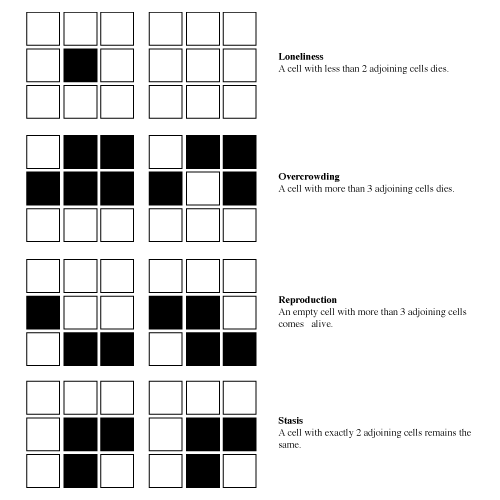
The Game of Life is a cellular automation. Its evolution is determined by some rules of life or death:
- Loneliness: Less than 2 neighbors -> Death
- Overcrowding: More than 3 neighbors -> Death
- Reproduction: 3 neighbors -> Birth
- Stasis: 2 neighbors -> No changes
Illustration from http://battleship.ru/virus/conway.html:
The following video explains the concept and its incredible possibilities:
Conway’s Game of Life Explanation
I choose Python and the library Pygame.
First step: Installing Python and Pygame:
Second step: implementation:
- Import Pygame in the first lines,
- Display a window thanks to Pygame,
- Fill this window with alive and dead cells (different colors in function of the state),
- Code the logic to calculate the number of neighbors for each cell to know the next state of each ones.
- (Optional) Implement events to improve your game: Pause option, reset game, increase or decrease the speed, start with a famous structure, etc).
Only the logic part will be explained here but the code can be found on my Github profile
https://github.com/Apiquet/Game_of_life_Conway
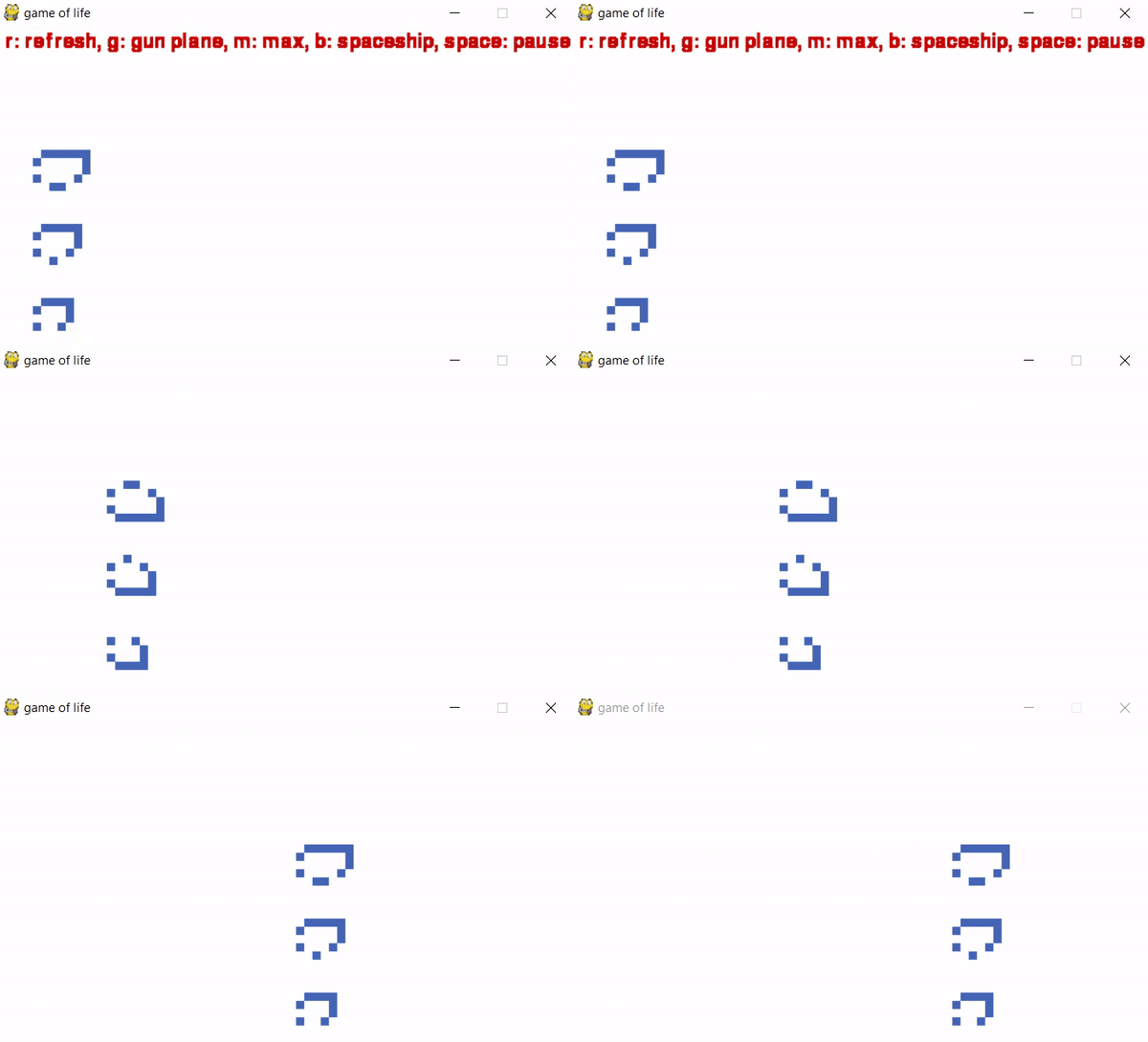
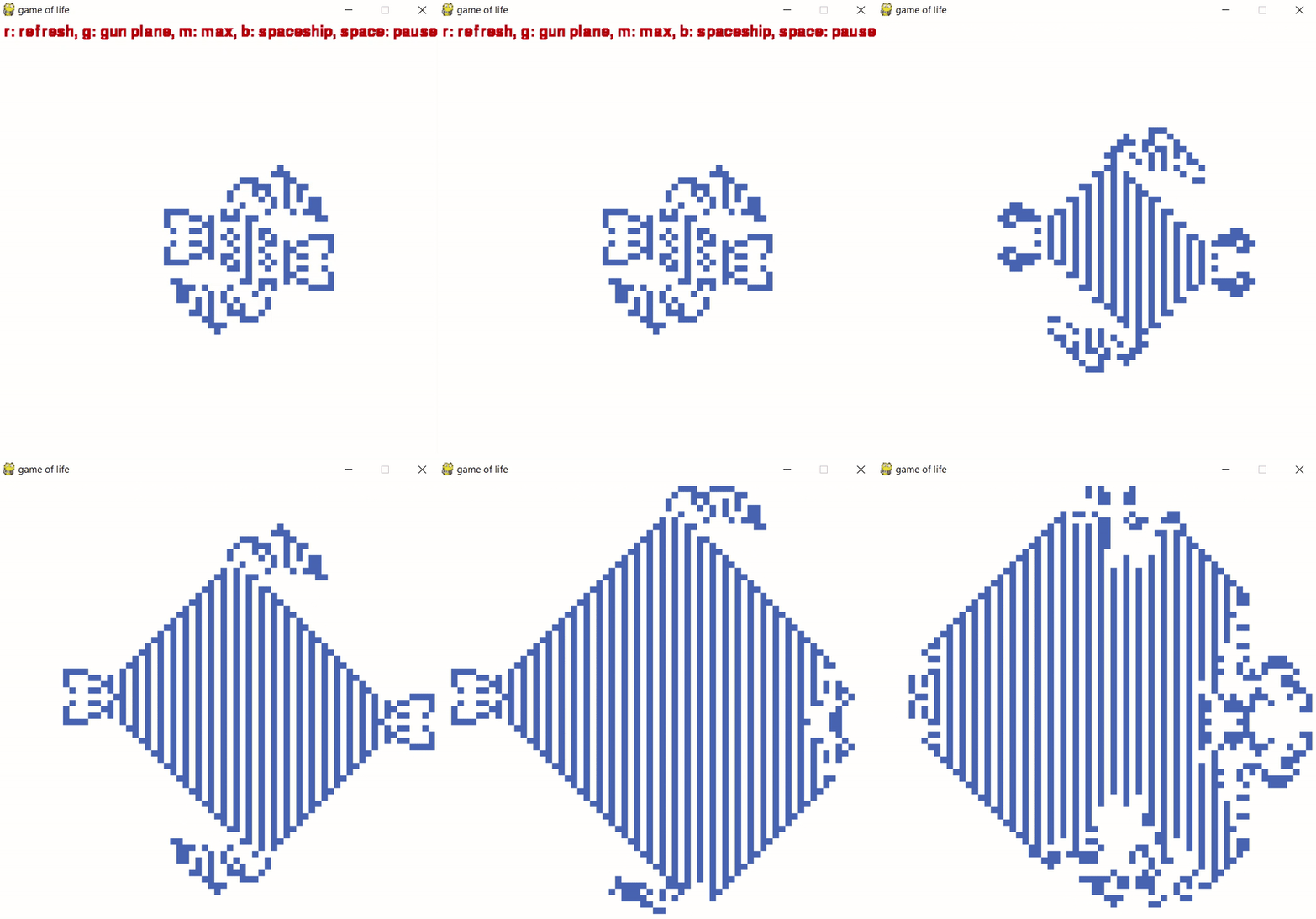
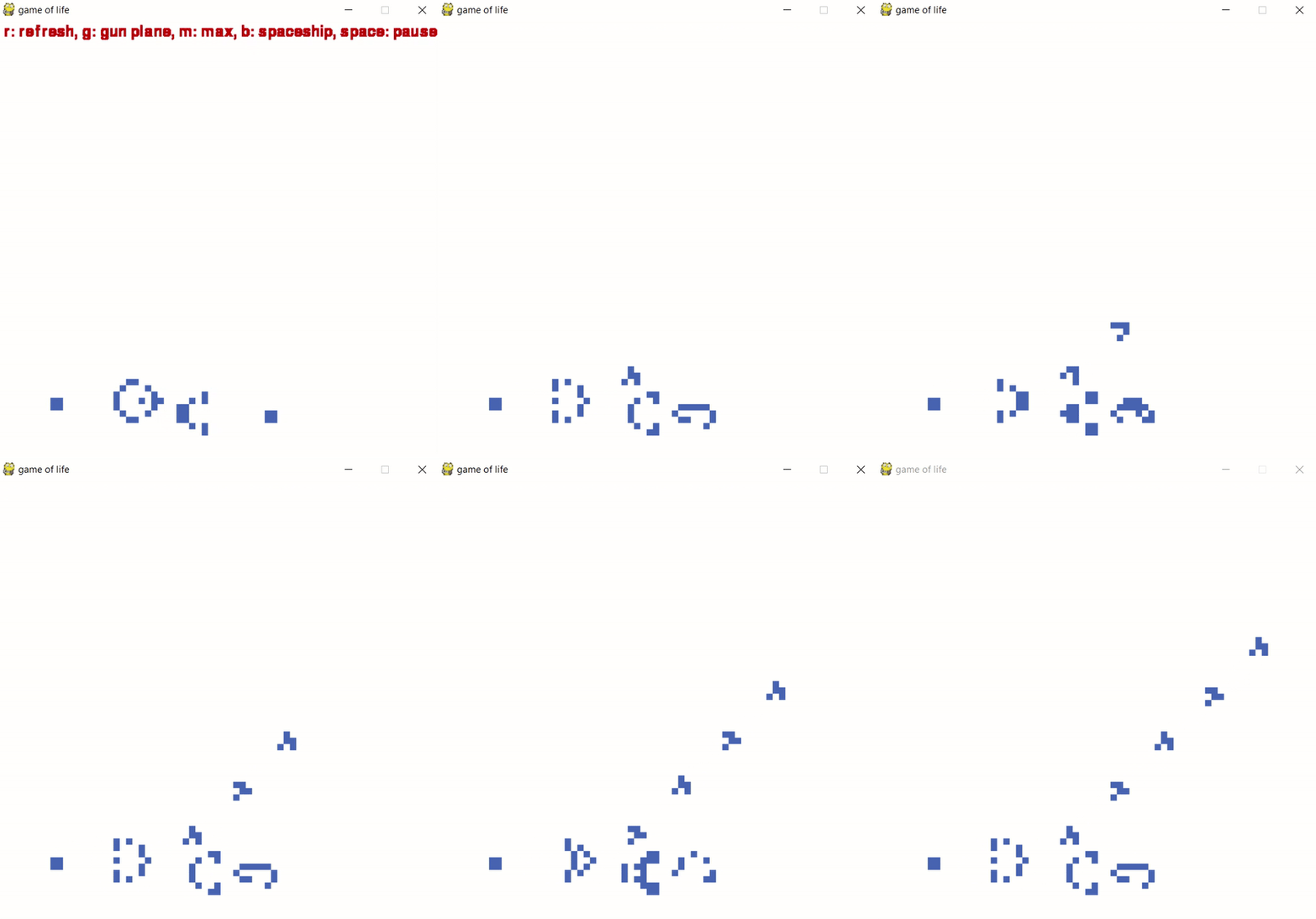
The code implements the possibility to start with some famous structure like glider gun, different size of glider and an exponential structure evolution:
- How to initialize the board:
return [[randint(0,1) for x in range(Nbr_Cell_x)] for y in range(Nbr_Cell_y)]allows you to initialize a random board thanks to the random library: from random import randint. It returns a random int between 0 and 1, 0 means death, 1 alive.
- How to find the number of neighbors:
There are many possibilities, the easiest is the following with many if statements:
def find_cell_neighbors(board, x, y):
    neighbors = 0
    if board[y][x+1]:
        neighbors+=1
    if board[y+1][x+1]:
        neighbors+=1
    if board[y-1][x+1]:
        neighbors+=1
    if board[y][x-1]:
        neighbors+=1
    if board[y+1][x-1]:
        neighbors+=1
    if board[y-1][x-1]:
        neighbors+=1
    if board[y+1][x]:
        neighbors+=1
    if board[y-1][x]:
        neighbors+=1
    return neighbors
But there are more “efficient” code that can be found online (example: https://github.com/scienceetonnante/GameOfLife/blob/master/GameOfLife_utils.py)
The goal is to find the number of neighbors of each cell to determine its evolution. Under 2 neighbors it dies, more than 3, it dies, 3 it lives, for 2 there is no change.
I hope you will enjoy creating your own Conway’s game of life, you can find my own game at the following link:
 AI Code Wizards